
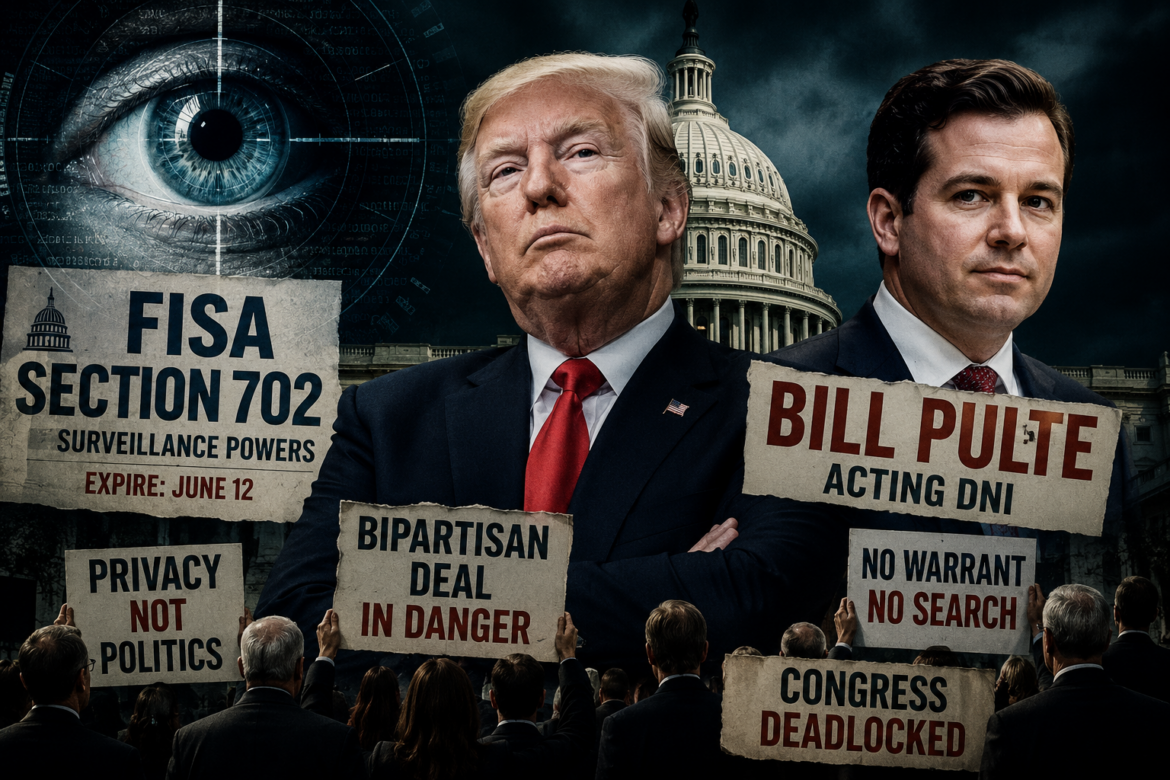
A major national security showdown is unfolding in Washington after President Donald Trump’s unexpected decision to appoint MAGA ally Bill Pulte as acting director of national intelligence triggered political turmoil on Capitol Hill and jeopardized the future of one of America’s most powerful surveillance programs.
Congress had appeared close to reaching a bipartisan agreement to extend Section 702 of the Foreign Intelligence Surveillance Act (FISA), a controversial but widely used intelligence authority that allows U.S. agencies to monitor foreign targets overseas. The authority is set to expire within days, and lawmakers from both parties had been negotiating a three-year extension combined with new oversight measures and transparency safeguards.
But Trump’s sudden intervention dramatically changed the political landscape.
Read Here – https://www.politico.com/news/2026/06/08/fisa-reauthorization-pulte-trump-00952622
The appointment of Pulte, who lacks traditional intelligence or national security experience, immediately sparked backlash among Democrats and even concern from several Republicans. Critics argued that placing a fiercely loyal political ally in charge of America’s intelligence apparatus at such a sensitive moment risked undermining trust in the system and could open the door to abuse of surveillance powers.
The fallout became clear early Friday morning when Senate Democrats joined a small number of Republicans to block a key procedural vote that would have advanced the long-term FISA extension before the June 12 deadline. The collapse of the vote has thrown the future of the surveillance authority into uncertainty and exposed growing frustration inside Congress over Trump’s unpredictable decision-making style.
For months, lawmakers had been working through difficult negotiations over how to reform Section 702 while preserving its national security capabilities. Supporters of the law argue it is essential for tracking foreign terrorists, cyber threats, and hostile governments. Intelligence officials have repeatedly warned that allowing the authority to lapse could weaken America’s ability to prevent attacks and monitor adversaries abroad.
However, critics across the political spectrum have long argued that the program sweeps up communications involving American citizens without requiring warrants. Privacy advocates and civil liberties groups have pushed for sweeping reforms, saying the government has repeatedly failed to prevent misuse of the surveillance database.
Despite those disagreements, negotiators believed they were approaching a workable compromise. Democrats and moderate Republicans had reportedly discussed new guardrails aimed at limiting searches involving Americans while still preserving the core structure of the intelligence program.
Then came Trump’s announcement.
According to lawmakers familiar with the negotiations, the Pulte appointment instantly destabilized fragile bipartisan trust. Democrats who had been willing to support the compromise began pulling away almost immediately, arguing they could no longer support expanding surveillance powers while Trump installed a political loyalist atop the intelligence community.
The political damage spread rapidly through both chambers of Congress.
Republican leaders privately acknowledged that the White House move complicated an already difficult negotiation. Senate Majority Leader John Thune publicly criticized Democrats for risking national security by blocking the extension, but he also admitted that the administration’s recent actions had created significant timing and political challenges.
Several Republican senators have reportedly expressed frustration behind closed doors, arguing that the White House failed to coordinate with congressional leadership before making such a politically explosive personnel decision.
Alaska Senator Lisa Murkowski openly questioned whether Trump fully considered the consequences of his actions on lawmakers attempting to pass critical legislation.
The dispute over FISA is now becoming another example of the growing tension between Trump’s impulsive political instincts and congressional Republicans attempting to manage difficult legislative battles ahead of the midterm elections.
In recent weeks, GOP leaders have already struggled to navigate other controversies tied to White House demands and surprise announcements. Lawmakers say repeated disruptions have complicated efforts to pass immigration legislation, budget proposals, and national security measures.
The FISA standoff, however, carries particularly high stakes because of the looming expiration deadline.
If Congress fails to act before June 12, intelligence officials warn that key surveillance authorities could temporarily lapse, potentially disrupting ongoing operations involving foreign threats. Lawmakers are now considering the possibility of another short-term extension simply to avoid immediate expiration while negotiations continue.
But even that option faces uncertainty.
House conservatives are using the current chaos to push for even stronger reforms, including requiring warrants before intelligence agencies can search foreign-collected data involving Americans. Some hard-line Republicans are also attempting to attach unrelated provisions to the legislation, including restrictions involving digital currency policy.
Meanwhile, Democrats are growing increasingly resistant to cooperating unless the administration changes course on Pulte.
Several Democratic lawmakers who were once viewed as likely supporters of a long-term extension have now publicly declared opposition. Some are demanding Pulte’s removal before negotiations can move forward again.
Representative Jim Himes, the top Democrat on the House Intelligence Committee and traditionally one of the strongest supporters of FISA authorities, warned that Democratic backing for the legislation is collapsing rapidly.
According to lawmakers familiar with internal discussions, many Democrats now fear that granting expanded surveillance powers under Trump’s current leadership structure could create political and legal risks they are unwilling to accept.
The controversy escalated further after Trump reportedly stated that Pulte should begin removing employees throughout the intelligence community. Those remarks intensified concerns among Democrats who already accuse the administration of politicizing federal agencies and attempting to reshape the bureaucracy around personal loyalty.
The situation now leaves congressional leaders scrambling to salvage a compromise before the deadline arrives.
Negotiations between the White House and lawmakers are expected to continue throughout the week, but there is little confidence that a breakthrough is imminent. Even if the Senate manages to pass an extension, House leaders still face fierce opposition from both privacy advocates and conservative hard-liners.
The battle over Section 702 has therefore evolved into more than a debate about surveillance powers. It has become a broader test of trust, political stability, and the relationship between the White House and Congress during a deeply polarized moment in American politics.
As the deadline approaches, lawmakers from both parties are warning that failure to resolve the crisis could carry serious national security consequences. Yet the political divisions surrounding Trump’s leadership decisions continue to widen, making a swift resolution increasingly difficult.
What once looked like a routine intelligence reauthorization has now become one of the most explosive political confrontations in Washington.