The global oil market is facing a major disruption as Iraq and the United Arab Emirates accelerate plans to build alternative export pipelines after traffic through the Strait of Hormuz collapsed during the ongoing regional conflict.
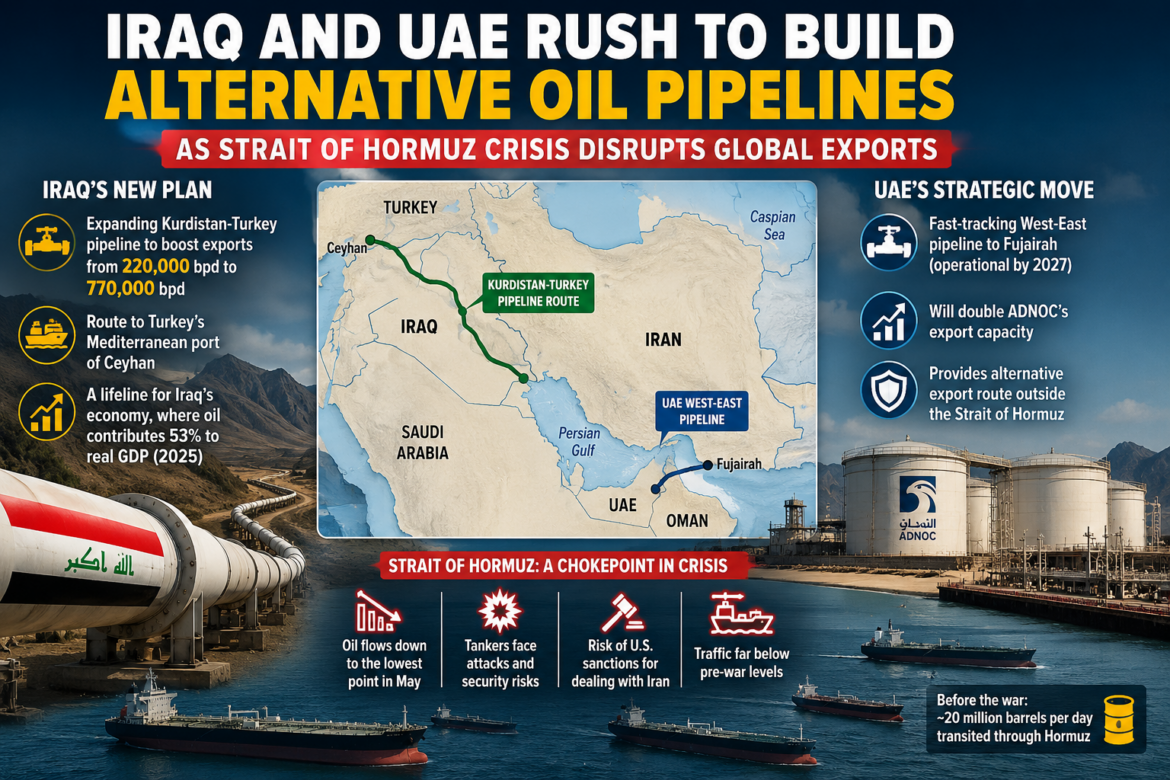
The Strait of Hormuz, one of the world’s most critical energy chokepoints, previously handled nearly 20 million barrels of oil and petroleum products every day. But escalating military tensions and attacks on shipping routes have severely reduced tanker movement, forcing Gulf nations to seek emergency alternatives.
Iraq has now approved an ambitious plan to expand exports through the Kurdistan-Turkey pipeline system. The project aims to increase crude shipments from 220,000 barrels per day to nearly 770,000 barrels daily. The route would connect Iraqi oil fields to Turkey’s Mediterranean port of Ceyhan, giving Baghdad a crucial export path outside the Persian Gulf.
The urgency comes after Iraqi officials revealed a dramatic collapse in exports through Hormuz. Iraq reportedly exported just 10 million barrels in April compared to 93 million barrels before the conflict escalated. Analysts say Iraq is among the most vulnerable producers because nearly all of its oil exports depend on Hormuz access.
Economic intelligence firm QuantCube Technology reported that cargo activity from Iraqi ports has nearly dried up since the war began. Experts warn that Iraq’s oil-dependent economy could face severe financial pressure if disruptions continue for an extended period.
Meanwhile, the UAE is accelerating construction of its strategic West-East pipeline to Fujairah. The new route is designed to bypass Hormuz entirely and is expected to significantly boost the export capacity of Abu Dhabi National Oil Company (ADNOC) once operational in 2027.
Read More – https://www.cnbc.com/2026/06/09/iraq-uae-hormuz-oil-pipelines-oil-iran-war.html
Abu Dhabi leadership has ordered faster completion of the project amid growing fears over global energy shortages. Unlike Iraq, the UAE still maintains access to export terminals outside the Strait of Hormuz, offering some protection against prolonged disruptions.
However, even these backup routes are increasingly vulnerable. Iran-backed attacks have targeted Saudi Arabia’s East-West pipeline, while drone strikes near Fujairah have disrupted loading operations at key UAE export terminals.
Energy analysts say the combined alternative capacity of Gulf pipelines remains far below prewar export levels. Existing bypass systems can handle only a fraction of the oil that once moved daily through Hormuz, raising concerns about future supply shortages and price spikes in global markets.
Shipping traffic through Hormuz remains at historic lows as insurers, shipping companies, and tanker operators avoid the region due to security risks. Some vessels reportedly require clearance from Iranian authorities before entering designated transit routes, while companies also face potential sanctions risks tied to regional cooperation.
The crisis is now accelerating one of the biggest strategic shifts in global energy logistics in decades. Gulf nations are pouring billions into new pipelines, export terminals, and infrastructure projects aimed at reducing dependence on the Strait of Hormuz permanently.
With geopolitical tensions still rising, the race to secure alternative oil routes may reshape the future of global energy trade for years to come.